Jemina Banu | Portfolio
Reactive NPCs
Jemina Banu / April 2026 (133 Words, 1 Minutes)
For my final year project at university, I researched in depth on to what makes NPC's reactive, how reactive NPCs improves gameplay and immersion, and different decision-making models such as finite state machines, behaviour tree's, goal-oriented action planning, and utility theory. Using the research, I created an artefact that illustrates how utility AI can improve the reactivity of an NPC. In early stages, the artefact displays simple circles that represent the NPC, each NPC either using a simple Finite State Machine system or the Utility System. The player can bring up a tab to adjust the tab, which the NPCs would then change colour.
Artefact Video Demonstration
Why Reactive NPCs?
I really like open-world action-adventure games where the player’s character can progress, grow, and change based on the actions the player makes. This could be something like their stats, moral alignment calculated over time based on the player’s actions, or even the player’s appearance, and most importantly, the players story progression. One minor issue i’ve had with some games is the lack of reaction from the NPCs to major story changes, or the lack of reaction to the player at all, making it feel as if the players actions weren’t as important.
Decision-Making Models
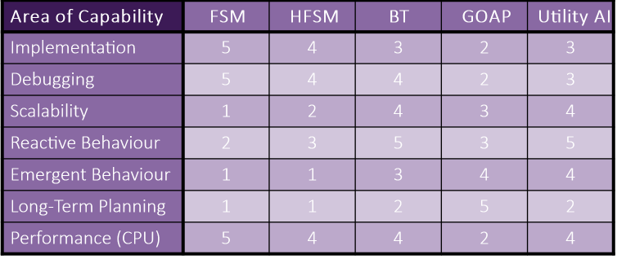
The figure below was created after my in-depth research on different decision-making models that are typically used to create the ‘brain’ of AI in the current games industry.
Dissertation
To read more in detail about my research, the artefact itself, and the results and findings, please read my dissertation.